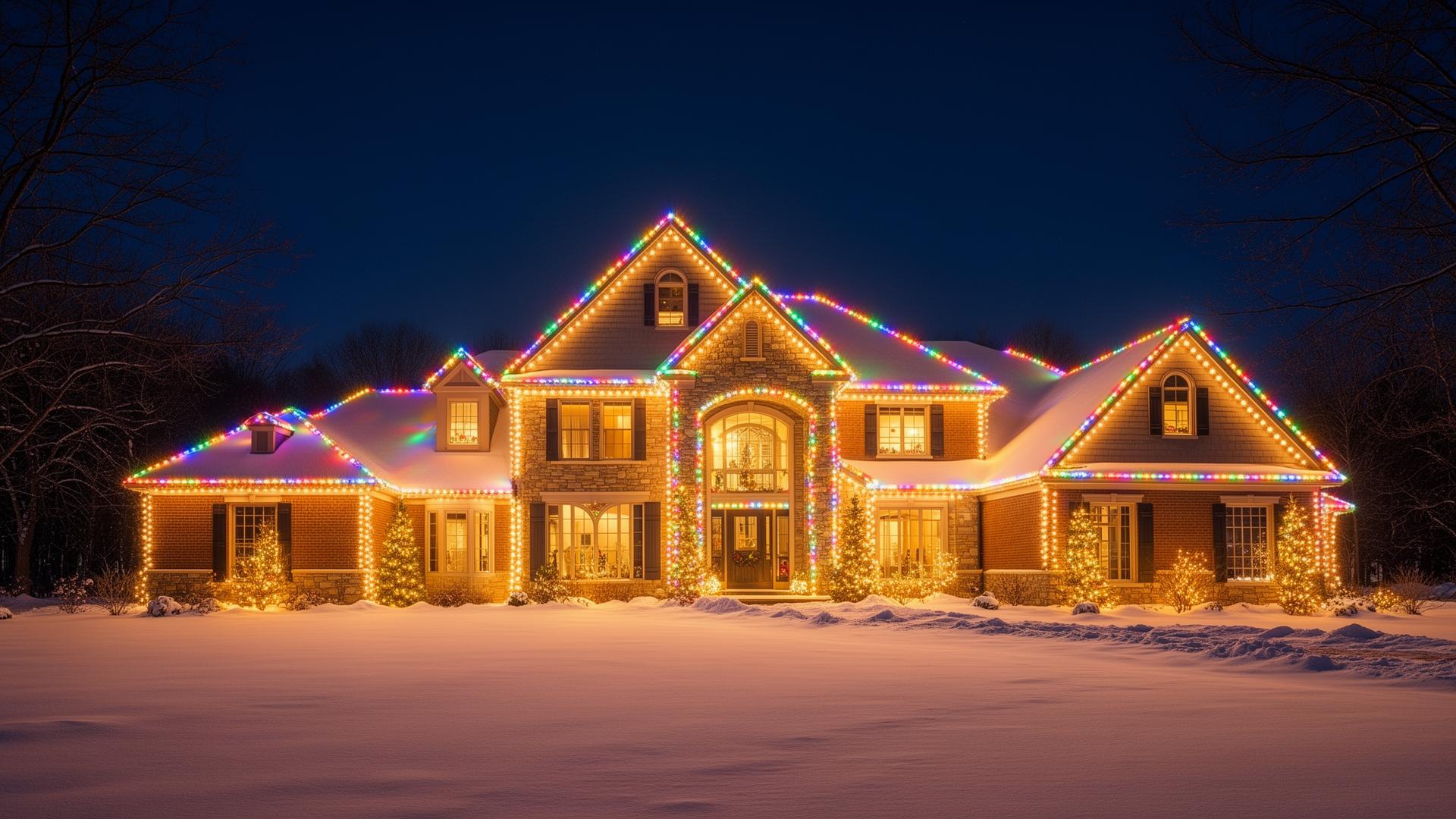
Lighting That Survives a Front Range Year
Permanent app-controlled LED channel, specified for altitude UV, hail impact, and the temperature swings that define a Denver year. Installed once, on your building, by the crew that quoted it.
- Aluminum channel, UV-stabilized lens
- Segment-replaceable after hail
- Free on-site property walk
Request Received!
Thank you for reaching out. We'll follow up within one business day to discuss your project.
Why a Denver Spec Is Not a National Spec
Permanent exterior lighting is sold as one product nationally. It should not be installed as one product nationally. A system that performs for a decade in a humid, low-altitude, hail-quiet market can degrade noticeably faster on a Denver metro roofline, and the reasons are specific and measurable.
Here is what the Front Range actually does to an exterior lighting system, and what we change because of it. If another installer cannot tell you these things, they are quoting a catalog rather than your building.
01Mile-high ultraviolet load
Denver sits above 5,280 feet and receives meaningfully more UV radiation than sea-level cities at the same latitude. UV is what chalks white PVC, yellows diffusers, and makes cheap lens plastic go brittle. Our channel extrusion is aluminum and the lenses are UV-stabilized polycarbonate, because a lens that survives ten Ohio summers can fail far faster on a south-facing Front Range roofline.
02Front Range hail corridor
The I-25 corridor from Fort Collins through Colorado Springs is one of the most hail-active stretches in North America. Any exterior system mounted on a Denver metro roof has to assume impact, not hope to avoid it. We mount channel tight to the fascia or tucked under the soffit line rather than standing it proud, so hail glances rather than lands square, and we spec replaceable channel segments so a damaged eight-foot run is an eight-foot repair and not a whole-house re-install.
03Daily 30 to 40 degree swings
A Denver February afternoon can hit 60 and the same night can drop to 18. That is not one freeze-thaw event per winter, it is dozens. Aluminum expands and contracts through that range, so mounting hardware has to allow for movement instead of fighting it. We use slotted mounts and expansion gaps between channel runs. Systems installed rigid in this climate are the ones that pop fasteners by year three.
04Semi-arid air and blowing grit
Denver is a dry climate, which is good news for corrosion and bad news for dust. Fine grit driven by downslope and chinook winds accumulates on horizontal lens surfaces and cuts output over a season. Our lenses are oriented to shed rather than collect, and a wipe-down is part of the annual service visit. In a humid market this is a non-issue; here it is the difference between year-five brightness and year-five haze.
05Wildfire smoke season
Late-summer smoke episodes leave a fine ash film on Front Range exteriors. It is cosmetic rather than structural, but it dulls a system that a homeowner is paying to look sharp. Scheduling a clean before the holiday season starts is something we build into the service calendar for permanent-system clients. It is a Colorado line item that simply does not exist in most of our franchise network.
06Intense winter sun, thin snow cover
Denver gets snow, but it frequently melts off a dark roof within a day or two of clear high-altitude sun. That matters because the system is visible far more of the winter here than in a market with persistent snow cover. Cosmetic install quality is not hidden under a snowpack for three months. Every channel seam, every wire transition, and every downlead is on display in January, so we finish them accordingly.
Is a Permanent System Right for Your Property?
Sometimes the answer is no, or not yet. We would rather tell you that on the property walk than sell you a system that has to come off next spring.
Strong fit
- Homes in HOA-governed master-planned communities where a permanent, always-tidy system is easier to get approved than seasonal strings and staples
- Two-story and walkout properties in Highlands Ranch, Castle Pines, and Broomfield where the ladder work is genuinely hazardous
- Owners who want the exterior lit for shoulder seasons, patio dinners, and Broncos and Avalanche nights rather than only December
- Commercial properties that need a fixed asset on the balance sheet instead of a recurring seasonal install line
Consider seasonal instead
- Homes with a roof replacement expected inside the next two years, common after a significant hail event. Replace the roof first, then mount the channel.
- Properties where a full architectural exterior repaint is planned
- Renters, or owners planning to sell inside a season
- Historic-district facades in older Englewood and Littleton corridors where a permanent fixed mount may not be the right call for the trim
The Hail Question, Answered Directly
This is the first thing a Denver metro homeowner asks, and it deserves a straight answer rather than a warranty brochure. Hail can damage a permanent lighting system. Anyone who tells you otherwise has not worked a Front Range spring.
What we control is the consequence. Three choices in how we build it change a hail event from a catastrophe into a repair:
- 1. Mounting geometry. Channel sits tight to the fascia or up inside the soffit line, not standing off the roof plane where it takes a direct vertical hit.
- 2. Segment replaceability. Runs are built in discrete lengths with serviceable joints. A damaged section is swapped without pulling the rest of the house.
- 3. Documentation at install. We photograph the finished system and give you the layout and part list. When you file a claim, that packet is what makes the difference between a fast approval and a fight.
One sequencing note that saves real money: if your roof is likely to be replaced soon after a storm, do the roof first. Mounting a permanent system to a roof that is coming off is paying twice. We will tell you that even though it delays our own job.
What we hand you at completion
- Photographed as-built of every elevation
- Channel run layout with segment lengths
- Component and part number list
- App handoff and controller access
- Written scope of what is and is not covered
Insurance outcomes are between you and your carrier. We supply documentation; we do not adjust claims or promise a result.
HOA Communities and Architectural Review
Large parts of the Denver metro are governed by homeowners associations, particularly the master-planned communities across Douglas County, Highlands Ranch, Broomfield, and the newer Aurora and Thornton developments. If your community has an architectural review process, exterior lighting may fall under it.
In practice, permanent channel systems often clear review more easily than seasonal alternatives, because the finished install reads as trim rather than as decoration and there is no annual cycle of ladders, staples, and dangling cords. Reviewers tend to respond well to a system that is invisible in daylight.
What we do to help: we provide the daytime appearance photos, the mounting detail, and the fixture specification in a form you can submit. We do not represent you to your board and we do not predict approval. Every association writes its own covenants, and yours governs. Ask us for the submission packet and we will put it together.
A Colorado Year, One System
Denver homeowners use outdoor space in nearly every month. The reason permanent systems land well here is that the lighting is useful long after the holiday decorations come down.
Spring
Warm white for the long evenings once the last snow clears. Post-storm is also when we do system checks across the metro.
Summer
Patio and deck lighting for the outdoor-living months, plus dimmed accent work that does not wash out a mountain-view backyard.
Fall
Game-day color, school colors, and the early sunsets that arrive fast once the season turns along the Front Range.
Winter
Full holiday programming without anyone on a cold roof, and continued curb appeal through the months when the snow melts off in a day.
Want the full spec sheet on materials rated for altitude and hail? Read our permanent outdoor lighting installation guide for Denver, CO.
Permanent Lighting FAQs
- Permanent lighting is a slim aluminum channel mounted along your roofline or soffit with individually addressable LED nodes inside. You control color, brightness, and patterns from an app. For Denver homes it is especially popular because Colorado homeowners want outdoor lighting for the full year -- not just December. You skip the ladder, the storage, and the seasonal install fee every year.
- Text or call. Denver Lighting Partners covers in-season service calls at no additional charge. We schedule rapid response during active season because nobody wants a dark patch on their house in December. Same-day service is typical for most issues.
Get a Front Range Spec, Not a Catalog Quote
We walk your property, measure the runs, note the exposures that matter at altitude, and put a fixed number in writing. Serving the Denver Metro Area.